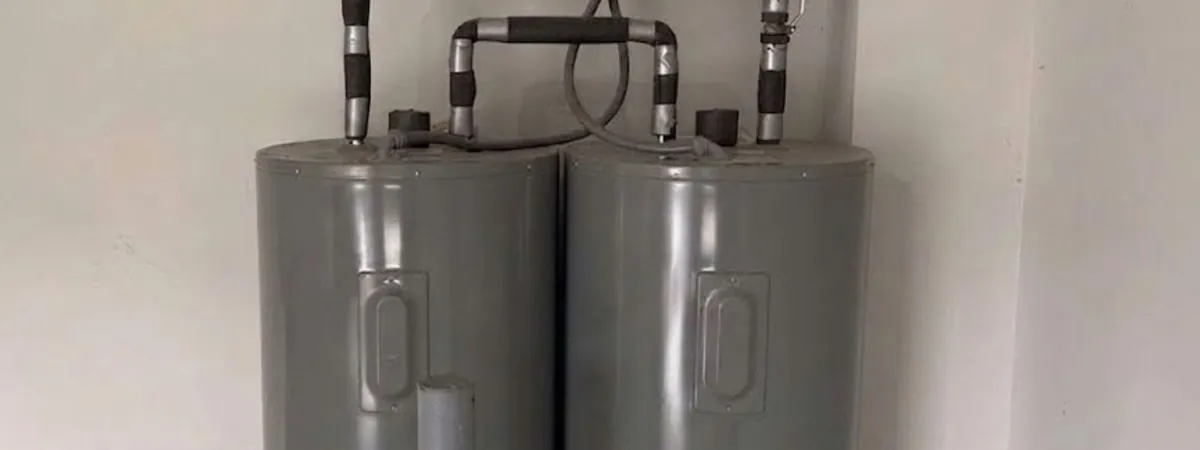
When the Tank Is Leaking or Flooding Your Floor
Water from the body of the tank usually means the steel shell has failed inside. Take these steps in order while you wait for the plumber.
- Turn the cold water valve on the pipe above the heater clockwise until it stops.
- Switch off the breaker for an electric heater, or set the gas control to off for a gas unit.
- If you smell gas, leave the building and call 911 and the gas utility from outside.
- Stay out of standing water near outlets, the panel, or any wet appliance.
- Let the water cool before touching the tank or a drain hose, because it can scald.
- Photograph the heater, the data plate, and the damage for your insurer or landlord.
Repair or Replace? How the Decision Gets Made
Not every failing heater needs to come out. The plumber looks at where the water is coming from and what the unit has already been through.
| What you find | Usually points to | Common outcome |
|---|---|---|
| Water seeping from the tank body or the bottom seam | Shell corrosion inside the tank | Replace. A tank that leaks through its wall cannot be patched. |
| Drip at the pipe fittings or the supply connectors | Loose or worn connection | Repair is often possible, see water heater repair. |
| Water from the pressure relief valve discharge pipe | Excess pressure or a worn valve | Test and repair first, then check the expansion setup. |
| No hot water, no leak, newer unit | Element, thermostat, or pilot assembly | Repair, since the tank itself is sound. |
| Rust-colored water and a heavy rumble when heating | Sediment and scale at the bottom | Flush or repair if the tank is dry, replace if it leaks. |
| Heater is old and needs its second repair | Cost of fixes adding up | Compare the repair price to a new unit with its warranty. |
Check the manufacturer date on the data plate and the warranty paperwork. We do not give an age limit because it depends on the unit and the water.
Which Kind of Heater Goes Back In
Most homes replace what they have, because the gas line, vent, or electrical circuit is already in place. Changing fuel or type is possible, but it adds work around the heater.
Your plumber can walk through the options at the unit and give a clear price before work starts.
Gas storage tank
This type needs a vent to the outside and a gas shutoff within reach. The existing vent is checked during the swap, since a poor draft is a safety problem.
Electric storage tank
An electric unit needs a circuit sized for its elements, and the plumber confirms the wiring matches the new unit. It has no flue, which helps in tight closets.
Heat pump water heater
The Department of Energy says these run two to three times more efficiently than standard electric resistance heaters. They need at least 1,000 cubic feet of air space and a surrounding temperature of 40 to 90 degrees Fahrenheit all year, so a small cold closet is a poor fit.
Tankless
A tankless unit is a bigger project than a like-for-like swap. See the tankless water heater page for sizing and venting.
Tank already failed?
Call (855) 575-2890 and describe where the water is coming from.
Sizing the New Heater to Your Household
Storage heaters carry a first hour rating. That number is the gallons of hot water the unit can supply in one hour of heavy use, and the Energy.gov sizing guide says to pick a model whose rating at least matches your peak hour.
Bell averages 3.49 persons per household by the 2020 Census, so a full house stacking showers, a dishwasher, and laundry in the morning can outrun a small tank. Tell the plumber who lives in the home and when the hot water is used most.
A heater that is too small runs out mid-shower. One that is too large costs more to buy and to keep hot.
What Twelve Grains of Hardness Does to a Tank
The Golden State Water Company 2026 report for the Bell-Bell Gardens system lists hardness from 137 to 280 mg/L, with an average of 210 mg/L, or about 12 grains per gallon. On the USGS scale anything over 180 mg/L is very hard.
Hard water leaves scale on elements and settles as sediment on the tank floor. That is why a heater in a GSWC area can get noisy or slow to heat.
Your bill shows if GSWC or another provider serves you, and addresses on other systems should ask that provider for a hardness figure. If you are on GSWC, ask about a water softener to protect the new unit.
How a Replacement Visit Runs
The visit is built around safety first, then a swap, then testing.
- 1
Make it safe
The plumber confirms the water, power, and gas are off and checks for gas or water damage around the unit.
- 2
Drain and disconnect
The old tank is drained to a safe spot and its supply, vent, and gas or electric connections are removed.
- 3
Set the new unit
The heater goes on a drain pan if the location calls for one, with new connectors and a discharge pipe on the relief valve.
- 4
Restore and test
Water is turned on and bled of air, then power or gas is restored and the flame or elements are checked.
- 5
Walk you through it
You are shown the shutoff valve, the temperature setting, and where the data plate and warranty details are.
Bracing and Permits
A water heater can tip in an earthquake, so ask the plumber about seismic strapping on the new tank. It is advice worth following, and it takes little time during the swap.
Permit rules vary, so ask the Bell building department. City Hall is at 6330 Pine Ave and the Building and Safety Division can be reached at (323) 588-6211.
What Moves the Price of a Replacement
Prices are not posted here, because the real number depends on your heater and your home. You get a clear price before work starts.
Homeowner policies usually respond to sudden accidental damage, such as a tank that bursts, but they typically do not pay for the worn-out heater itself or for a slow leak. Read your policy or ask your insurer. Renters should tell the landlord right away and check their renter's insurance.
Call (855) 575-2890 and ask for the actual price for your heater.
Call (855) 575-2890Water Heater Replacement questions
Yes. The 24/7 emergency line is answered at night and on weekends, and same-day appointments are offered when available. While you wait, shut off the cold supply and the power or gas, and keep the area clear.
A leak from the tank body usually means replacement, while a bad element, thermostat, or fitting can often be repaired. The plumber finds the source of the water first, then explains both options.
Same-day appointments are offered when available, and a like-for-like swap is the simplest case. A change of fuel or location can take longer because of extra gas, vent, or electrical work.
About 75 percent of Bell homes are renter-occupied, so this comes up often. Tell your landlord or property manager as soon as you see water, and they decide on the repair. Keep photos and messages in writing.
Permit rules vary, so ask the Bell building department. Building and Safety is at City Hall, 6330 Pine Ave, and the plumber can tell you what the job involves.
It is possible, but a heat pump needs at least 1,000 cubic feet of air space and a surrounding temperature of 40 to 90 degrees Fahrenheit. Cold, cramped closets are a poor fit, so ask for a site check before you decide.
Not until the power or gas is off and the water has cooled. Hot water can scald, and a hose run to the wrong place can do more damage. If you are unsure, shut off the supply and wait for the plumber.