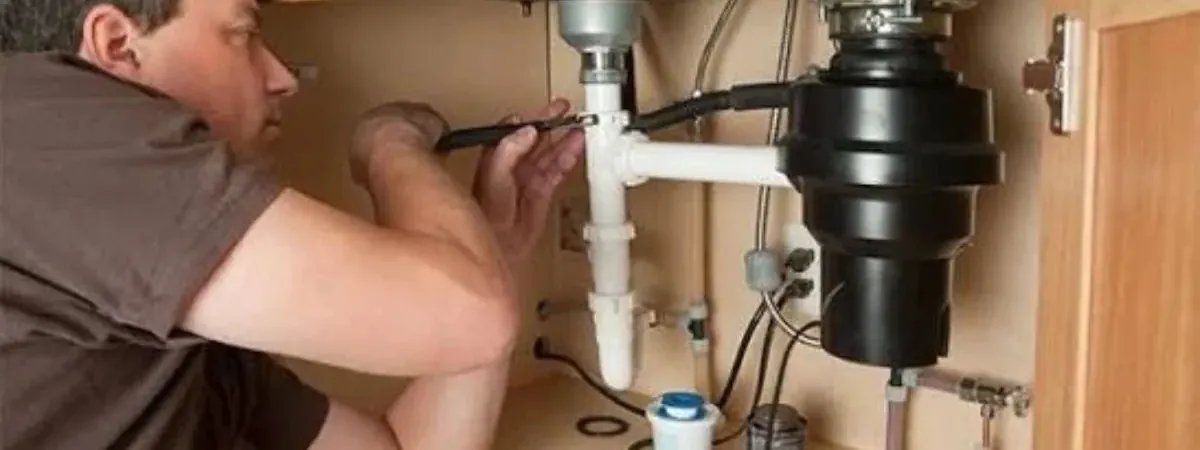
Disposal jammed, humming or leaking right now
A humming sound with no grinding means the motor has power but the flywheel is locked. Something hard, such as a bone, a fruit pit or a utensil, is usually wedged between the shredder ring and the plate. The motor can overheat if it keeps trying, so turn it off.
A leak is a different problem. Water under the sink can come from the sink flange at the top, the dishwasher hose, the drain outlet on the side or a crack in the housing. Only the last one means the unit is finished.
Dry the cabinet, set a bowl under the drip and watch where the new water appears. That tells the plumber more than a guess does.
Safe jam reset with the power off
Most homeowners can try this once. Stop if anything feels wrong and call.
- 1
Cut power
Turn off the wall switch, then unplug the unit under the sink or switch off its breaker. Never put a hand in the drain, even when it looks off.
- 2
Find the hex socket
Look under the disposal for a small hex socket in the center of the base. A hex wrench often comes taped to the unit or in the original box.
- 3
Work the wrench
Insert the wrench and turn it back and forth until the shaft moves freely all the way around.
- 4
Remove the item
Use tongs or pliers from above to lift out whatever was stuck. Do not use your fingers.
- 5
Press the reset
Wait a few minutes for the motor to cool, then press the red reset button on the bottom. Restore power and run cold water while testing.
Where disposal leaks come from
The location of the drip points to the part that has failed. Some are cheap fixes, and some mean a new unit.
| Leak location | Likely cause | Repair or replace |
|---|---|---|
| Top, around the sink flange | Dried out plumber's putty or loose mounting ring | Reseat the flange, usually repair |
| Side, at the drain outlet | Worn gasket or loose bolts | Replace the gasket, usually repair |
| Dishwasher inlet | Cracked hose or loose clamp | Replace the hose and clamp |
| Bottom of the unit | Cracked housing or failed seal inside | Replace the unit |
| Along the trap and pipes | Loose slip nuts or worn washers | Tighten or replace the trap parts |
| Around the reset button | Internal seal failure | Replace the unit |
A leak from the base or the housing is a common reason for choosing a new disposal.
Slow drain, bad smell and clogs
If water backs up into the sink and the disposal runs normally, the clog is probably past the unit in the trap or the branch line. Grease, coffee grounds and starchy food scraps such as rice and pasta settle there and harden. Running more water will not clear it.
A smell is usually food film on the shredder ring and splash guard. Ice and citrus peel may freshen it for a day. If gurgling also appears in a neighboring sink or tub, the blockage may be in the main line, which is a job for drain cleaning and sometimes sewer line cleaning.
Not sure whether to repair or replace?
Call (855) 575-2890. Describe the sound or leak and we will explain your options.
Dishwasher drain and the air gap
The dishwasher usually drains through the disposal, so a blocked disposal can make the dishwasher leave dirty water at the bottom. The connection point has a knockout plug that must be removed when a new disposal is installed with a dishwasher. A plumber checks that step so the machine drains properly.
The dishwasher drain hose runs up and over before it connects, either through a high loop or an air gap on the countertop. That bend keeps sink water from flowing back into the dishwasher. If the air gap spits water, it is often clogged and needs cleaning.
Repair or replace the disposal
A disposal is a motorized appliance, so there is a point where fixing it stops making sense.
| Sign | Repair is reasonable | Replacement is the better choice |
|---|---|---|
| Jammed and humming | A hex wrench frees it and it spins freely | It jams again right away |
| Trips the reset often | Debris was the cause | Motor overheats with nothing stuck |
| Leak at a gasket or hose | New seal or hose fixes it | Leak is from the housing |
| Loud grinding or rattle | A foreign object is rattling inside | Bearings or blades are worn |
| Does not turn on | Reset or wall switch problem | Motor is dead after power is confirmed |
What affects disposal repair pricing
A jam clearing and a new disposal with a reconnected sink are not the same visit. We quote after the plumber sees the unit.
Homeowner policies usually respond to sudden accidental water damage but not to a worn-out appliance or a slow leak. Read your policy or ask your insurer. Renters should tell the landlord and check their renter's policy.
Call (855) 575-2890 to hear the price for your disposal.
Call (855) 575-2890Renters, shared kitchens and older buildings
In Bell about 75 percent of homes are renter occupied, and 28.6 percent of homes are in buildings with two or more units. In those places the disposal usually belongs to the owner. Tell the property manager in writing, keep photos of the leak and ask who approves the repair.
Older kitchen plumbing can add trouble. Census data shows about 67.6 percent of Bell housing was built before 1960, so drain lines under the sink may be old. If a disposal leak turns up damp cabinet floors, ask about leak detection to confirm where the water came from. We also help neighbors in Cudahy with the same kitchen problems.
Garbage Disposal Repair questions
Yes. The line answers 24/7. Turn off the power to the unit, keep your hands out of the drain and call.
If water is leaking, close the stop valves under the sink and set a bowl underneath. Same-day appointments are available when the schedule allows.
Not necessarily. A hum means the motor has power but the blades are jammed. Cut the power and use a hex wrench in the base to free it, then press the reset button.
It can be the sink flange, a drain gasket, the dishwasher hose or a cracked housing. A leak from the body of the unit usually means replacement.
No. Use tongs or pliers with the power off and the unit unplugged or at the breaker.
Grease, bones, fruit pits, coffee grounds in large amounts, and starchy foods like rice and pasta can jam or clog. Run cold water for a short time after use.
Usually the owner is responsible for fixtures that came with the unit. Tell your landlord in writing and ask who will approve the repair. If an owner or tenant hires a plumber directly, the CSLB License Check at cslb.ca.gov shows whether the license is active and lists a plumbing classification.