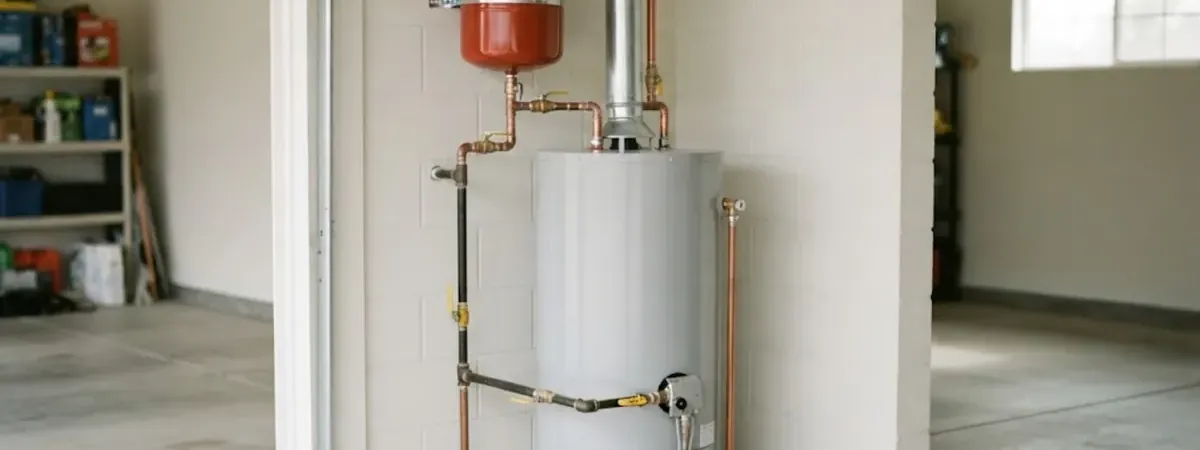
Four Choices to Settle Before Install Day
Most delays on a planned job come from decisions made late. Sort these first and the day itself is simple.
Fuel
Gas, electric, or a heat pump model. Staying with your current fuel is the least work, and switching means new lines, circuits, or venting.
Tank or tankless
A storage tank holds hot water ready. A tankless unit heats on demand and has its own gas and venting needs, covered on the tankless water heater page.
Size
Storage heaters are matched by first hour rating, the gallons of hot water supplied in an hour. Aim for a rating at least equal to your peak-hour demand.
Location
Garage, closet, attic, or utility room. The spot sets the vent route, the drain path, and how much room the plumber has.
What Each Type Asks of Your Home
The table shows what the building needs to provide, based on the Department of Energy and Energy.gov sizing guides.
| Heater type | What it needs | Watch for |
|---|---|---|
| Gas storage | Gas line, flue to the outside, combustion air, shutoff within reach | A weak draft or an undersized gas line |
| Electric storage | A circuit rated for the elements, clear space around the tank | Panel capacity for the added load |
| Heat pump | At least 1,000 cubic feet of air space, 40 to 90 degrees Fahrenheit year-round, a condensate drain | Cold or cramped closets are a poor fit |
| Tankless gas | A gas line sized for the burner, a vent run, enough flow at the needed temperature rise | Whole-house units need a flow of at least 3.25 gallons per minute |
Heat pump models run two to three times more efficiently than standard electric resistance heaters, according to the Department of Energy.
Venting and the Gas Line
A gas heater has to push exhaust out of the building and bring in air to burn. The flue must slope, seal at every joint, and end where it should. Changing the heater's size or location can mean new vent pipe, even if the old one worked.
The gas line has to deliver enough flow to the burner, and the connection needs a shutoff valve and a drip leg where the plan calls for one. If you ever smell gas, leave the building and call 911 and the gas utility from outside.
Other gas work is covered under plumbing installation, which is helpful if you are adding a line for a range or dryer at the same time.
The Safety Pieces Around the Tank
A water heater is more than a tank. Several small parts make the installation safe and are part of the scope you should ask about.
Pressure and temperature relief valve
The valve opens if pressure or temperature climbs too high. Its discharge pipe runs to a safe place and is never capped.
Expansion tank
Heating water makes it expand. When the building has a closed system, an expansion tank gives that extra volume a place to go instead of loading the pipes and the relief valve.
Drain pan
A pan under the tank catches slow leaks in places where water could damage a floor or a ceiling below.
Seismic strapping
Southern California shakes, and a tank can tip. Ask the plumber to strap the new heater to the wall framing.
Want a price for your layout?
Call (855) 575-2890 and describe the fuel, tank size, and where the heater sits.
How Install Day Goes
The sequence is the same for most jobs, with extra steps added for fuel changes.
- 1
Walk the site
The plumber checks the location, the vent route, the shutoffs, and how the old unit is plumbed.
- 2
Prepare the connections
Gas, electric, water, and vent runs are adjusted to fit the new model.
- 3
Set and secure
The heater is placed on its pan, strapped, and connected with new fittings.
- 4
Add the safety parts
The relief valve discharge, expansion tank, and drain line are installed or updated.
- 5
Fill, light, and test
The tank is filled and purged of air, then fired or powered up and checked for leaks and a clean flame or correct element operation.
The Permit Question for a Bell Address
Permit rules vary, so ask the Bell building department. Building and Safety at City Hall, 6330 Pine Ave, enforces the city's plumbing and building codes, and it reviews plans and inspects work. The phone number is (323) 588-6211, and the online portal is at bellca.portal.opengov.com.
Ask what is required before the day you schedule the job. The California Plumbing Code applies statewide, and the city decides how it is carried out locally.
Renters should know that the owner or property manager usually has to approve the work. About 75 percent of Bell housing is renter-occupied, so check with the landlord first.
Hard Water and Your New Heater
The Golden State Water Company report for the Bell-Bell Gardens system lists hardness between 137 and 280 mg/L, averaging 210 mg/L. The USGS classes that as very hard, and it applies to GSWC addresses only.
Scale is the usual cost of hard water. An annual flush of the tank, a look at the anode rod, and a water softener all help protect a new unit. Keep the warranty paperwork and the data plate photo, since both settle questions later.
What Shapes the Installation Price
No prices are listed on this page. The number depends on your heater and your home, and you get a clear price before work starts.
A planned install is not an insurance event, since homeowner policies generally cover sudden accidental damage and not routine upgrades. Renters should ask the landlord who pays. If the old heater failed and caused water damage, that part may be a separate claim to ask about.
Call (855) 575-2890 for a price based on your actual setup.
Call (855) 575-2890Water Heater Installation questions
Start with what your home already has. Keeping the same fuel means the least change to gas lines, venting, or wiring. A switch can be worth it for efficiency or space, but it adds work that should be priced first.
Check the first hour rating on storage models. It tells you the gallons the heater can supply in an hour, and it should at least match the busiest hour in your home. Bell averages 3.49 people per household, so count showers and laundry together.
Only if there is at least 1,000 cubic feet of air space and the area stays between 40 and 90 degrees Fahrenheit. A tight, cold closet is a poor match. Ask for a site check before ordering.
Permit rules vary, so ask the Bell building department. Building and Safety can explain what applies to your address and how an inspection is scheduled.
The 24/7 line takes calls at any hour, and same-day appointments are offered when available. For a planned job, call and describe what you want, and the dispatcher will set a time.
You can ask your landlord or property manager, but they decide on upgrades. Put the request in writing, mention any safety concern, and keep a copy.