Sewage backup tonight: what to do before the plumber arrives
These four moves limit the mess and make the visit go smoother.
Stop all water
No toilets, showers, sinks, washers or dishwashers. Every gallon you send down has nowhere to go.
Protect the room
Lift rugs and belongings off the floor, and put towels at the low edges of the affected area.
Keep people clear
Children, pets and anyone with a weak immune system should stay out of standing sewage. Wash hands well after contact.
Document it
Take photos and note the time. You may need them for a landlord, a property manager or an insurer.
Reading the backup: which drain tells you where the clog sits
Water takes the easiest path out. When the main line is blocked, wastewater rises at the lowest opening in the building, which is often a bathtub, shower or floor drain on the ground level. Fixtures higher up may only gurgle or drain slowly.
That pattern is why a main line problem is easy to mistake for a sink problem. If a plunger on one fixture changes nothing and a second drain acts up, the blockage is past the branch lines. A fixture-level cable from regular drain cleaning cannot reach it, and a larger machine is needed.
Backup pattern and what it suggests
A quick look at which drains are affected points to the likely location.
| What you notice | Likely location of the clog | Next step |
|---|---|---|
| One sink slow, everything else normal | Branch line near that fixture | Regular drain cleaning |
| Tub or floor drain fills when the toilet flushes | Main line downstream of the branches | Main line cleaning through a cleanout |
| Water in a floor drain after laundry | Main line or the laundry standpipe branch | Camera look and main line cleaning |
| Gurgling in several fixtures, slow flushing | Partly blocked main line | Cable or jet, then a camera check |
| Wet patch or odor outside, no clog indoors | Broken buried pipe | Camera diagnosis and repair |
Cleanouts and how the plumber gets in
A cleanout is a capped pipe that gives direct access to the sewer line. It is often outside near the house, though in some buildings it sits inside or at a roof vent. If you can find yours, tell the plumber, and do not open it yourself because wastewater may rise out of the opening.
With no cleanout, the plumber may need to pull a toilet or use another access point. That adds time, which is one of the factors on the cost list below.
Main line backed up right now?
Call (855) 575-2890 any time. A licensed plumber answers the 24/7 line.
Equipment used on a main line
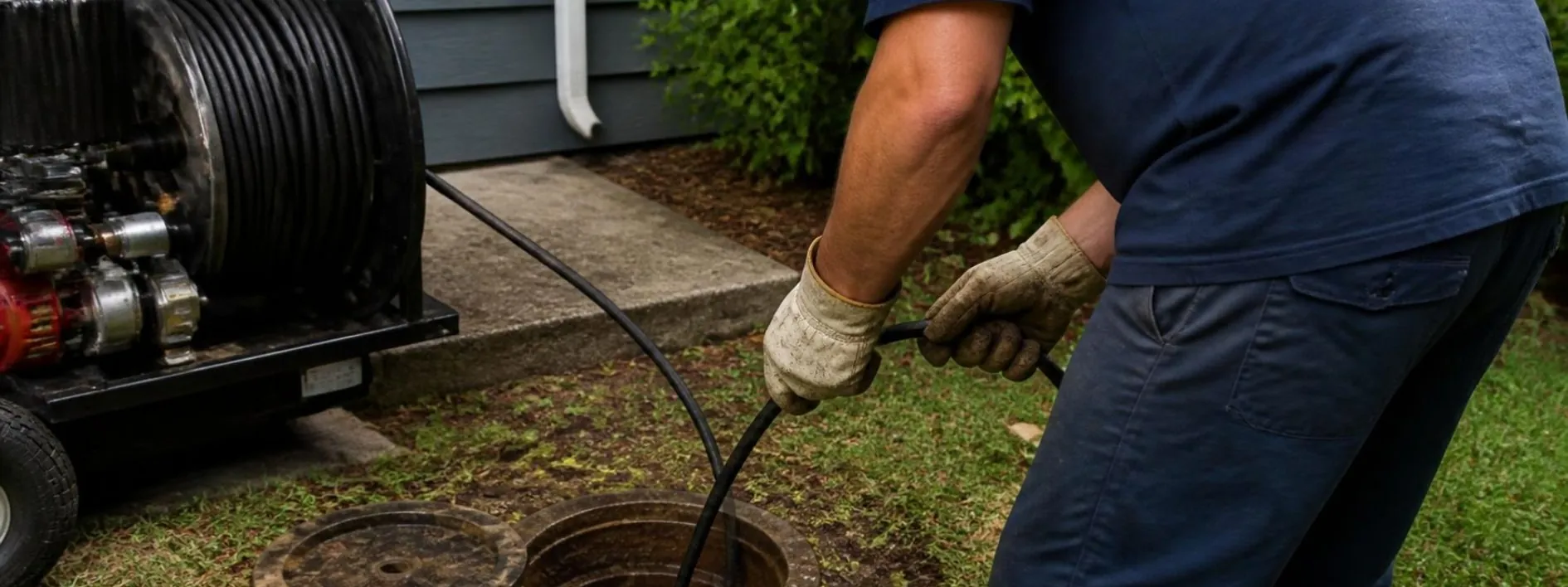
The plumber chooses between three approaches. A heavy cable machine with a cutting head breaks through roots and thick buildup. A hydro jet washes grease and silt from the pipe wall, and a drain camera shows the cause.
Often the work combines methods. A cable restores flow quickly, a jet cleans the pipe, and a camera look afterward confirms what is left. If the camera shows damage, the plumber explains the repair options on the sewer line repair page.
Storm drains and yard drains are a separate system
Sewer lines carry wastewater from the building. Storm drains and downspout lines carry rain, and they are cleaned for a different reason, usually silt and leaves. Yard drains that clog can flood a patio or driveway.
If a drain outside your property seems to be the problem, ask Bell Public Works whether it is a city or private line. Do not assume. A camera can trace a private line, and the plumber can tell you what the pipe is connected to.
Tell the right people
A backup affects more than the plumber and you.
Landlord or property manager
Send a written note with photos and the time. In a multi-unit building, a main line blockage can affect neighbors too.
Neighbors in the same building
If you share a line, a quick word helps them stop water use before wastewater rises in their unit.
Your insurer
Ask whether the policy covers sewage backup damage. Not every policy does.
The city
If you think the blockage is in a city line, ask Bell Public Works where your responsibility ends.
Shared lines in Bell's rental housing
The Census ACS reports that about 75% of Bell's occupied homes are rented, and 28.6% of units sit in buildings with two or more units. Multi-unit buildings often share a single lateral, so one blockage can back up several units at once. That is a reason to call early and to tell the property manager right away.
About 67.6% of the city's housing was built before 1960. If cleaning has to be repeated on an older line, ask for a camera look to see why.
Source type: Census ACS housing data
What affects sewer line cleaning prices
The price follows the job, not a flat list. Before work starts you receive a clear price after the plumber has seen the line and how it is accessed.
Homeowner policies may treat sewer backup differently from other water damage, and they usually do not pay for routine cleaning itself. Check your policy or ask the insurer. Renters should tell the landlord and check what renter's insurance covers for damaged belongings.
Call (855) 575-2890 to hear a clear price for your sewer line before work begins.
Call (855) 575-2890Sewer Line Cleaning questions
Yes. The line at (855) 575-2890 is open 24/7 for backups. Stop water use, keep everyone out of the wet area and call. A licensed plumber is sent to Bell and nearby towns, and same-day appointments are offered when available.
When more than one fixture is affected, or a tub fills when you flush, the main line is the likely location. A single slow sink points to its own branch.
No. Chemicals do not reach far enough to clear a main line, and they leave a hazardous liquid in standing wastewater.
It is a capped access pipe on the sewer line. Look near the house exterior, in a yard or by a driveway. Tell the plumber what you find, and do not remove the cap. If a new cleanout is needed, the California Plumbing Code, which is based on the UPC, governs that work, and permit rules vary, so ask the city building department.
Usually the landlord or property manager handles the building's main line, but it depends on the lease and the cause. Report it in writing at once and keep photos. You can still call the 24/7 line.
It often is, especially if the line has clogged before. The camera shows what caused the blockage and whether the pipe is damaged.