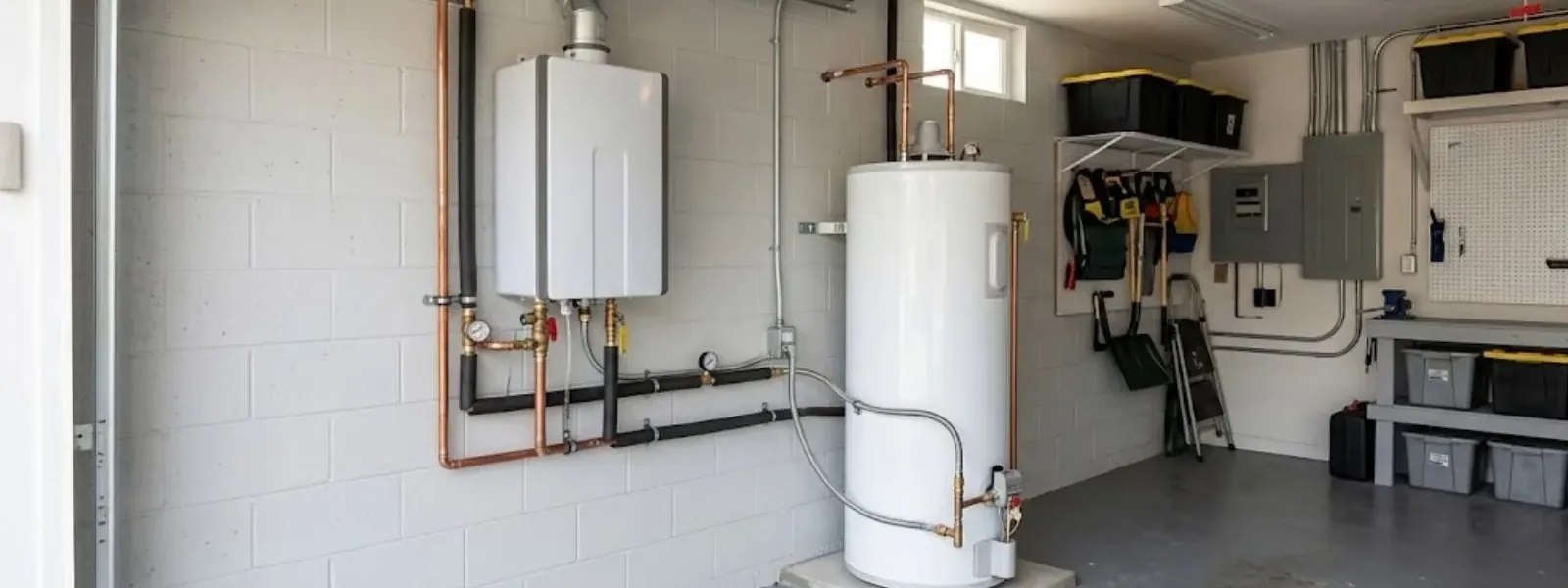
The sizing method in four steps
Tankless heaters are rated by the temperature rise they can deliver at a given flow. Work through these in order.
- 1
List what runs together
Decide which hot water devices could be on at once, such as a shower and a kitchen faucet, or two showers and a dishwasher.
- 2
Add their flow rates
Each fixture lists gallons per minute on its label or in its manual. Add up the ones you listed. This is your peak flow.
- 3
Find the temperature rise
Subtract the temperature of your incoming water from the temperature you want at the tap. Cold incoming water means a larger rise.
- 4
Match to a unit
Compare your flow and rise with the manufacturer's performance chart. The guide's minimum for a whole-house demand-type unit is a flow rate of at least 3.25 gallons per minute.
A worked example, using made-up numbers
The figures below are illustrative only. They are not measurements for Bell or for any home, and your incoming water temperature is different.
| Item | Illustrative value | Note |
|---|---|---|
| Shower 1 | 2.0 gal/min | Label rating, assumed |
| Shower 2 | 2.0 gal/min | Both showers on at once |
| Kitchen faucet | 1.5 gal/min | Dishes during morning rush |
| Peak flow (sum) | 5.5 gal/min | 2.0 + 2.0 + 1.5 |
| Desired hot water | 120 degrees F | Assumed setting |
| Incoming water | 60 degrees F | Assumed, not a Bell figure |
| Temperature rise | 60 degrees F | 120 minus 60 |
With these numbers, you would look for a unit that can deliver a 60 degree rise at 5.5 gal/min. A chart that stops short of that means the unit will fall behind.
Why the numbers shift from home to home
Two houses with the same unit can get different results. Colder incoming water raises the temperature rise, which lowers the flow a unit can deliver. A family that showers at once needs a higher peak flow than one that staggers use.
Low-flow fixtures help, since they shrink the peak number. Before you buy, measure or look up the real ratings on your fixtures rather than guessing. Use your own incoming temperature, which a plumber can measure or help you estimate.
Hard water matters for a tankless in Bell
Golden State Water's Bell-Bell Gardens report for 2025 shows hardness of 137 to 280 mg/L, averaging 210 mg/L. The USGS scale calls anything over 180 very hard. A tankless heater has narrow passages inside its heat exchanger, and scale narrows them further.
The practical tie-back is a maintenance plan. Ask the maker how often to flush the unit and whether water treatment is recommended for your supply. The figures apply to Golden State Water addresses only, so check your bill for your provider.
Source type: water utility quality report
Checks beyond the heater size
A correctly sized unit still fails if the house cannot support it.
- Gas line size and capacity, since tankless units draw gas at a high rate
- Venting route and clearance to windows and walls
- Electrical outlet for the controls and fan
- Location and access for service and flushing
- Condensate drain if the unit is a condensing model
- Existing recirculation or hot water loop arrangements
Want your numbers checked?
Call (855) 575-2890 and a plumber can walk through the sizing for your fixtures.
Gas and venting are not DIY
Gas lines and exhaust vents are safety systems. A line that is too small starves the burner, and a bad vent can spill exhaust into the home. If you smell gas, leave the building and call 911 and the gas utility from outside. Sizing is something you can learn. Gas and vent work belongs to licensed plumbers.
Reading a manufacturer performance chart
Most makers publish a table that lists the flow a unit delivers at several temperature rise values. Find the row for your rise, then read across to the flow. If that flow is below your peak, the unit is too small for your plan.
Round toward a larger unit only if the gas line and vent can support it. A bigger unit needs more gas, so sizing up on paper can create a problem in the wall. Ask the plumber to confirm both numbers together.
Tank or tankless, a fair comparison
Storage heaters are rated by first hour rating, the gallons of hot water the unit can supply in an hour. You choose one whose rating at least matches your busiest hour. Tankless units skip the storage idea, so the question becomes whether it can keep up with your peak flow at the right temperature.
Neither option is better for every home. Tankless frees floor space, while storage suits homes that cannot upgrade the gas line or vent. See tankless water heater work and water heater installation for what each involves.
Permits and rental homes
Switching to tankless often changes gas piping and venting. Permit rules vary, so ask the Bell Building and Safety Division at City Hall, (323) 588-6211, before work starts. Census data shows about 26.5% of Bell housing is owner-occupied, so tenants should get landlord approval for any such change.
Readers in Cudahy and Maywood should ask their own city offices, since each town has its own rules.
If your water has scale problems
Where scale is heavy, water treatment can protect a tankless heat exchanger. Not all treatment is equal, so ask what each option does and does not change. See water softener and filtration for the options a plumber can discuss.
Quick answers
Add up the gallons per minute of the fixtures that could run together. The Energy.gov guide gives 3.25 gallons per minute as a minimum for whole-house demand-type units, and many homes need more.
It is the output temperature you want minus the temperature of the water coming in. Colder incoming water means a bigger rise.
It rates storage heaters by the gallons of hot water the unit can supply in an hour. Pick one at least as large as your busiest hour of use.
Often not without a check. Tankless units draw gas at a high rate, so a plumber should measure the line before you buy.
If Golden State Water serves you, the 210 mg/L average is classed as very hard, so scale is a real concern. Ask the maker about flushing and treatment.
Gas and venting work should be done by a licensed plumber. Permit rules vary, so ask the Bell Building and Safety Division. The piping and vent rules for that work come from the California Plumbing Code, which is based on the UPC.