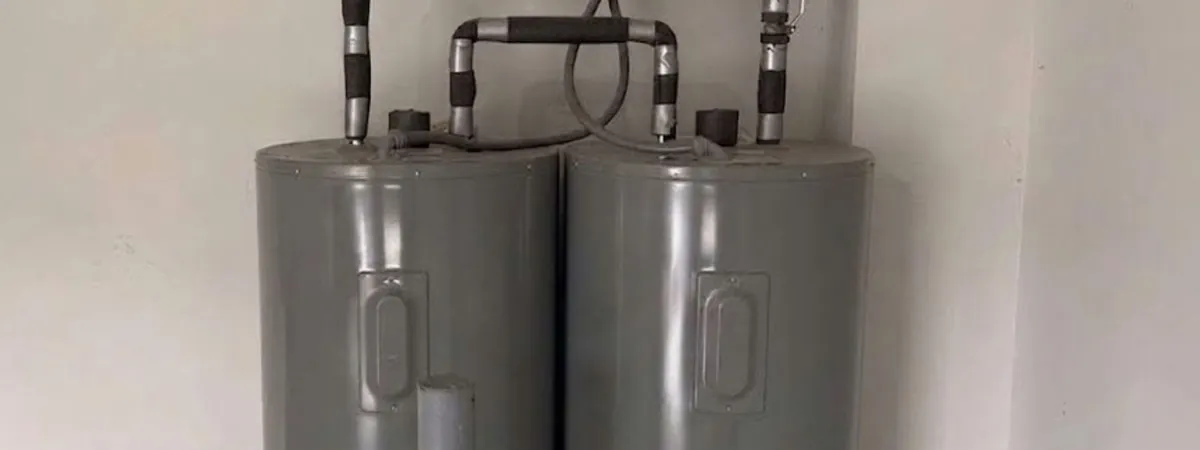
Safety comes before the wrench
A 240-volt circuit feeds these elements, and the tank is full of conductive water. Turn off the double breaker for the heater, then confirm with a non-contact tester or meter that the terminals are dead. A switch on the wall is not proof.
If you cannot find the right breaker, or the panel is unlabeled, stop. Guessing at a panel is how people get hurt.
What the element does and how it fails
A typical electric tank has two elements, an upper and a lower, each wired through its own thermostat. The upper one heats the top of the tank first, and the lower one does most of the work after that. Each is a coiled metal rod inside a sheath that carries current and gets hot.
Elements fail in two main ways. The coil can break, which leaves an open circuit and no heat. The sheath can also corrode or crust over with scale, which makes the element overheat and trip the thermostat or burn through.
Which symptom points to which element
The pattern of hot water usually tells you where to look before you pick up a meter.
| Symptom | Likely cause | Check first |
|---|---|---|
| No hot water at all | Upper element or upper thermostat | Breaker, reset button, upper element |
| Hot water runs out fast | Lower element failed | Lower element and thermostat |
| Water warm but never hot | Lower element weak or scaled | Resistance test on lower element |
| Breaker trips repeatedly | Element shorted to ground | Insulation test, do not reset again |
| Rumbling or popping noise | Scale on elements | Inspect during replacement |
Replacing the element
These steps assume a standard screw-in element and a heater you can reach safely. Read the full list before you begin.
- 1
Cut power and verify
Switch the breaker off, tag the panel so nobody flips it back, and test the wires at the element for voltage.
- 2
Close the cold inlet
Shut the valve on the cold line above the heater. Leave the hot taps in the house available for the next step.
- 3
Drain below the element
Attach a hose to the drain valve, open a hot faucet inside to let air in and drain until the water level is below the element you are changing. Hot water scalds, so let it cool first.
- 4
Open the panel and remove the wires
Take off the access cover and the insulation. Photograph the wiring, disconnect the two wires and unscrew the element with a socket made for it.
- 5
Inspect and install
Check the opening for scale and clean the gasket seat. Fit the new element with its gasket, snug it down and reconnect the wires as photographed.
- 6
Refill before power
Open the cold inlet and keep a hot tap running until water flows steadily with no sputtering. Only then restore the breaker, because an element heated in air burns out almost instantly.
Testing the element before you buy one
A multimeter set to resistance will confirm a dead element. With the wires off and power off, touch the probes across the two element terminals. A working element shows some resistance, while an open reading means the coil is broken.
Then touch one probe to a terminal and the other to the metal tank flange. Any reading there means the element is shorted to ground and should be replaced. Check the element rating on the old part or the heater's data plate so the new one matches voltage and wattage.
Hard water and elements in Bell
Golden State Water's Bell-Bell Gardens report for 2025 showed hardness of 137 to 280 mg/L, averaging 210 mg/L, which the USGS scale calls very hard. In an electric tank, that mineral content settles on the lower element and bakes into a crust.
If you are pulling an element and see heavy scale, treat that as a sign the tank needs sediment flushing too. A crusted element runs hotter and fails sooner, so a new part in a scaled tank may not last long. These figures only describe Golden State Water addresses, and your bill shows your actual provider.
Source type: water utility quality report
Not sure it is the element?
Thermostats, high-limit switches and wiring cause the same symptoms. Call (855) 575-2890 to talk it through.
When to stop and call a licensed plumber
Call a plumber if the tank leaks from the body, since a leaking tank cannot be repaired. Call if the element will not unscrew, if the flange threads are damaged, or if the breaker trips again right after replacement. Those point to wiring faults or a failing tank rather than a simple part.
A plumber handles the draining and the safe disposal of hot water, and the visit includes testing both elements and thermostats before replacing anything. See water heater repair for what that covers. If the tank is the problem, water heater replacement is the next conversation.
Elsewhere in the service area
Electric tanks fail the same way in nearby towns, and the 24/7 line covers them.
Maywood
Residents there get water from mutual water companies, so ask yours about hardness. Coverage details are on the Maywood page.
Cudahy
The city lists three water providers and does not say who serves which address. Check your bill, then see service in Cudahy.
Quick answers
No. The element sits in the water, so the level must drop below it first. You can leave the lower part of the tank full when changing the upper element.
Not always. If one has failed and the other tests fine, you can replace just one. Many people change both when the tank is already open, since the second one has the same age and the same scale.
The most common cause is power on before the tank was full. Elements need to be under water. Air pockets from a poorly bled system can do the same.
No. Gas units use a burner and a thermocouple or a similar flame sensor. If you smell gas, leave the building and call 911 and the gas utility from outside.
If Golden State Water serves your address, the average of 210 mg/L is classed as very hard. That speeds scale buildup on elements. Ask your provider if you are served by a different company.
Permit rules vary, so ask the Bell Building and Safety Division at City Hall, (323) 588-6211. A like-for-like element swap is different from replacing the whole heater.