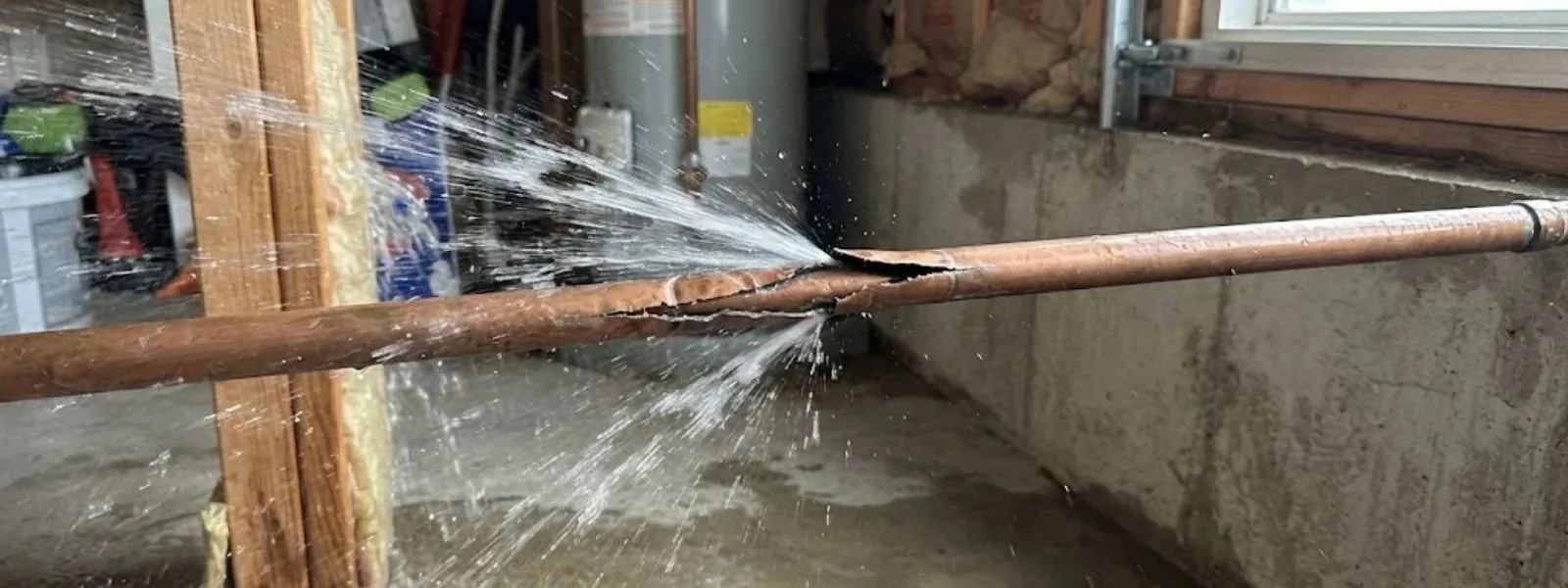
Why copper pipes fail in the first place
Copper lasts a long time, but it is not immune. Pinholes form when water slowly eats through the pipe wall from the inside, often at spots where flow is fast or where the water chemistry is harsh. Pinholes in one pipe run, with others clean, usually come from a local cause such as a bad joint or a nearby fitting.
Splits happen differently. A freeze, a hard water hammer or a bad bend can swell and crack the wall. Corrosion on the outside shows up as green or white crust, often where a leak has been dripping for a long time.
Repair methods compared
Each fix suits a different failure. This table covers the usual choices and their limits.
| Method | Best for | Limit |
|---|---|---|
| Repair sleeve or clamp | Pinhole or small split | Often a short-term patch on aging pipe |
| Slip coupling | Cut-out section with room to slide | Needs a straight, clean run |
| Soldered coupling | Permanent in-line repair | Pipe must be dry and heat must be safe nearby |
| Push-fit coupling | Tight spots, no torch wanted | Pipe end must be clean, round and undamaged |
| Replace a longer run | Several leaks on one line | More wall access and more labor |
| Full repipe | Leaks on many lines | Largest job, done by a licensed plumber |
What each repair involves
A short look at how plumbers handle the common fixes.
Sleeve or clamp
The sleeve wraps around the damaged spot and compresses a rubber seal. It works on a clean, round pipe and is useful when the leak must be stopped quickly.
Cut and couple
The plumber cuts out the bad length, deburrs the ends and joins a new piece with couplings. This is the usual permanent repair for a single failure.
Solder joint
Soldering needs a dry pipe, clean copper and flux. Steam from residual water prevents a good joint, so the line is drained and a wet-line tool is sometimes used.
Push-fit joint
A push-fit fitting grips the pipe without heat. It helps in tight spaces near wood framing, but the pipe must be properly prepared or it will weep.
What housing age tells us about Bell pipes
Census data from the 2007 to 2009 American Community Survey found about 67.6% of Bell housing units were built before 1960, and 26% in 1939 or earlier. That age data does not tell us which material is inside any wall. Many older homes have had parts of their plumbing replaced over the decades.
The practical tie-back is that plumbing in a house of that age is often a patchwork of old and newer sections. A leak in one spot does not prove the whole system is bad, but it is a reason to ask the plumber to look at the pipes on either side of the repair.
Source type: US Census American Community Survey
Do not ignore a pinhole
A pinhole sprays a fine mist that can soak insulation and drywall behind the surface. By the time a stain appears, the wall may have been wet for weeks. Shut the water off and have it fixed rather than waiting for the spot to dry.
What to do while you wait for a plumber
These steps limit damage and leave the pipe ready for repair.
- 1
Close the nearest shutoff
Use the fixture stop if the leak is at a sink, or the main valve for a leak in a wall. Open a faucet at the lowest point to drain the line.
- 2
Dry and document
Wipe the area, set a bucket and photograph the leak and any stains. Photos help with insurance or a landlord claim.
- 3
Do not wrap and forget
Tape or putty only slows a leak briefly. Pipe damage may be larger than it looks, so treat any patch as temporary.
- 4
Keep the area clear
Move belongings and clear access to the shutoff and the wall so the plumber can work without delay.
Found a wet wall or a green crust?
Call (855) 575-2890 and describe where the pipe is. The line answers 24/7.
When patching stops making sense
Think about repiping when pinholes keep appearing in new spots, when water shows rust or blue-green stains, or when several joints leak in one year. Each repair costs money and opens a wall, and a pipe that is thin everywhere will fail again soon. A plumber can often show you the inside of a cut section, which makes the wear obvious.
A full repipe replaces the supply lines through the house. It is a bigger job, so ask what the repair covers and in what order the work happens. For related options, see repiping and burst pipe repair.
Permits and who does the work
Plumbing work in California is done by licensed contractors, and you can check any license at cslb.ca.gov. Look for an active license with a plumbing classification. Permit rules vary, so ask the Bell Building and Safety Division at City Hall, (323) 588-6211, whether your repair needs one. The California Plumbing Code, based on the UPC, is the statewide standard for this kind of pipe work.
Nearby towns
The same questions come up across the area. Coverage details are on the Cudahy page and the Maywood page.
Quick answers
A clamp or sleeve can seal a pinhole on a clean, round pipe. It is usually treated as a stopgap, since the wall around the hole may be thin. Cutting out the section is more durable.
Both work when done correctly. Soldering is common and permanent but needs a dry pipe and safe heat. Push-fit suits tight spaces and wet lines, as long as the pipe end is clean and undamaged.
Green or blue-green crust is copper corrosion, often from a slow leak at a joint. The pipe under the crust may be thin, so have it checked.
Repeated leaks in different places, discolored water and several failed joints are warning signs. Census data shows many Bell homes are older, but age alone does not decide it. A plumber can inspect cut sections.
Policies differ. Many cover sudden damage but not slow corrosion, and we cannot read your policy for you. Photograph the damage and ask your insurer early.
We cannot say. The Census data records home age, not pipe material. A plumber can identify what runs through your walls.